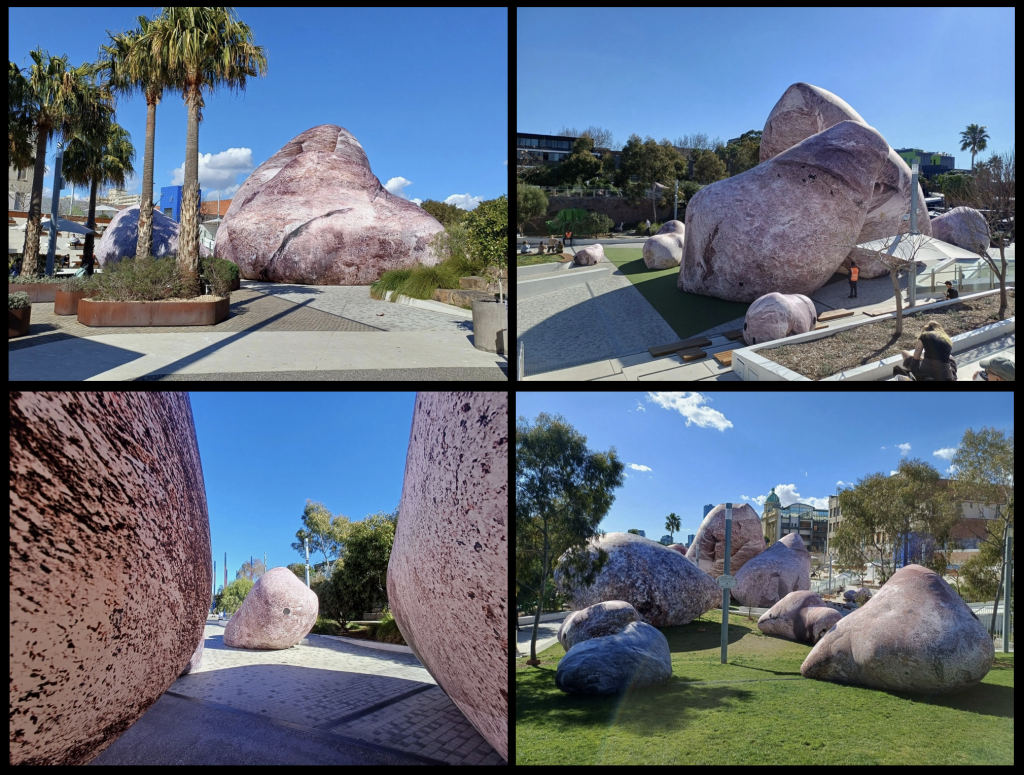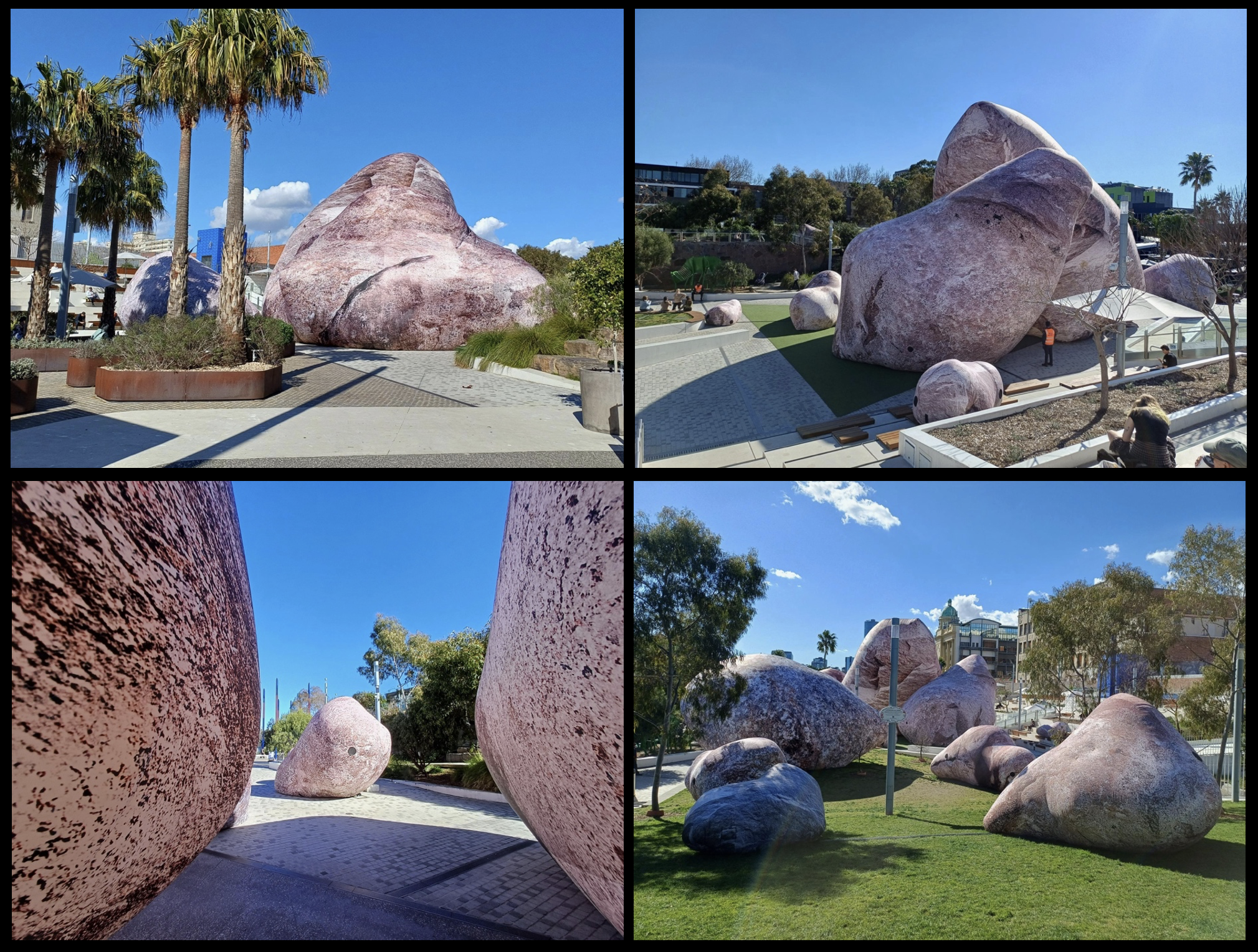
Sometimes, the purported distinction between fiction and reality, the Reel world and the Real world, becomes light, airy, almost indistinguishable.
It’s like a scene sampled from a science fiction film (or comic book adventure) and then spliced into the heart of a municipal space – something straight out of The War of the Worlds, The Body Snatchers, or The Adventures of Tintin: The Shooting Star.
A lot of things have happened here, over the years, strange people and even stranger occurrences, but nothing as outlandishly spectacular as this. In fact, you’ve never seen these phenomena here before.
Yes, it’s as if they’ve appeared out of nowhere, landed overnight perhaps, proliferating and populating Prahran Square and its surrounding sections, including the Lawn and even a small stretch of the Terrace. Enormous, irregular-shaped structures, imposing and intimidating, that resemble massive meteors, pods or capsules. Their shapes, colours, and patterns are familiar, even recognisable (akin to massive boulders and rock formations), but their sheer scale, eccentric surfaces, and awkward arrangement has something stupendous, perhaps sublime, even otherworldly about it.
Beholding these odd entities, moving around and between them, the neural pathways of my memory fire up with a plethora of references from cinema, popular science, and literature: space junk from our own solar system, debris from a galaxy far, far away, alien life forms biding their time, waiting for the right moment to hatch, sprout, spread, and seize control.
The crisp winter light of the afternoon sun casts distorted shadows (from the surrounding, towering light poles) onto these bewildering behemoths, branding and imprinting them with a peculiar symbolism, further accentuating their strangeness.
On closer inspection, however, your initial and immediate appraisal shifts. These objects are not what they seem. What appears as solid matter turns out to be an inflated fabrication. What resembles the striated pattern and smooth texture of weather-honed stone is a high-definition replication (photographic and photogenic).
The insights of Jean Baudrillard, the fatal strategist and self-penned aeronautical missionary, comes to mind: these structures are not exactly real (mineral formations extracted from elsewhere then transported and reinserted here); nor are they extra-terrestrial (actual fragments of a comet or meteor that entered earth’s atmosphere and ended up here); no, they are perhaps intimations of the hyper-real: more real than real, simulations engendered en masse from codes and programs, memory-banks and cybernetic models, CGI and AI stock images.
Defined as an ‘interactive art experience’, Iwagumi: Air Scape by Eness doesn’t align with your existing visual paradigm: it’s not, exactly, an art installation (with clear-cut boundaries or demarcations between the work and the viewer, its space and your space, inside and outside); it’s not, precisely, public sculpture (a permanent construction that can be touched, handled, mounted, or sat, shat, or pissed on by humans – or non-humans).
It is, rather, an ‘Event’ in myriad senses of the term: an unprecedented, even singular, experience (for visitors to Prahran Square, at least); a temporary happening with a specific timeframe (it’s not here forever, just over a fortnight: 1-17 August); a heavily policed and closely monitored project (under surveillance via CCTV and round-the-clock security personnel); an interface between creativity and community, albeit with strictures and prohibitions (‘this is an artwork. Please be gentle. Do not kick or punch the artwork. Children must be supervised. Thank You!’).
It’s a story as old as storytelling itself, perhaps. When something new, colossal, even monstrous, interrupts and inhabits the pedestrian spaces and routine rhythms of daily life, one can look, maybe even linger, but seldom touch.
And yet, the irresistible temptation remains: to reach out, with the hands, for a closer look (and feel). Is that so surprising or uncommon? Perhaps not, given that the experience of art, in its sundry forms, is never purely or absolutely visual. On the contrary, the interpretation of art involves the grasp of the eyes, the illuminating touch of the hands, and the enabling, enfranchising, and explanatory gaze of language (or, more precisely, theory: cue the philosopher Jacques Derrida, ‘Theory itself, the word and the concept of theory itself, is dependent on a rhetoric of visualising, visuality, vision, seeing, optics. To theorise means, as you know, to see, to contemplate, to gaze, as in theoria’).
If this wasn’t so, if the activity of seeing didn’t involve multiple senses (the eye, the ear, and the hand, even the nose and the mouth – synaesthesia), numerous codes (audio, visual and linguistic), and myriad conventions (literary, cinematic, musical, philosophical, art historical), then we would struggle to descry, let alone describe, what lies before and around us, like the hypnotic, surreal, and pneumatic curiosity of Iwagumi.